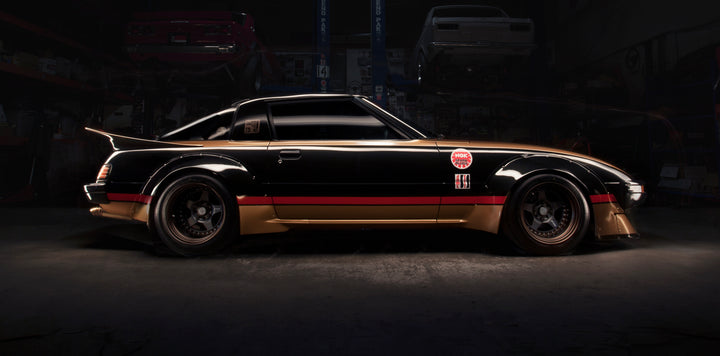






Alright, last time we left of HERE the TA22 Celica had the body modified to accept the new over-fenders and wheels as well as the new bumpers and looked a little something like this:
It’s now time to start prepping the chassis for paint. The customer decided he was looking for a cleaner overall look for the car so we decided that removing the screwed-on rocker panels covers and trim pieces would be a good place to start. This car was in great condition overall with minimal rust considering it’s age but the look of the rocker panel cover on the passenger side was one area that I knew had the potential to get ugly.
Sure enough, when I removed the panel a big chunk of filler came right off with it in the area that had previously been repaired. Not exactly what I was hoping to see but not a big surprise given the look of the rocker cover.
The first step is to remove all of the filler and take it down to the metal to get a good idea of what you’re working with. As you can see there was a good amount of filler on top of the damage.
The reason I believe there wasn’t much of an attempt to remove much of the damage in the first place is because in the TA22 rocker panel there is very little, if any access to get behind the damage to work the dent out. Taking that into consideration and the sheer amount of damage, I decided we would get a better result if we cut out the damaged portion all together and made a replacement panel.
This is a relatively easy panel to duplicate as long as you can match the exact radius of the bend in the bottom of the panel. This is when a large bin of various-sized tubing and a profile gauge comes in handy. Once you have the tube with the correct radius it’s a matter of clamping and hammering until you achieve the right shape. Note the line on the pipe that shows the center line of the tube and the line on the panel so you can make sure the bend is perfectly straight.
This is the profile taken from a straight section of the rocker.
Here’s a little comparison of the new panel and old to give you an idea of just how bad it was.
After the area is prepped and treated for corrosion, I make the first set of tack welds, and lots of them.
After all the welding is complete it’s ground down to a nice metal finish… like it never happened.
The rear section of the rocker also had some damage from the same incident but this part wasn’t nearly as bad.
Because the damage was minimal, instead of cutting out the panel I used an awesome little tool called a stud gun that is designed to easily pull dents from areas where you don’t have access the backside where a typical hammer and dolly would normally be used. The gun fuses studs to the panel which you can then use a slide hammer to pull out the damage unlike the old style that would require drilling holes.
After some careful pulling the panel is straight again and will now require only a very light skim of filler. Here’s a shot of before:
And after… sorry for the bad photo.
In order to remove the rocker covers completely we now need to weld up all of the holes that were previously used to attach it, I think there were about 24 in total. The customer also asked to have the side badges removed which was difficult one for me personally because I love them so much but I think it will go well with the overall look he is going for.
We weren’t originally planning on taking this car down to bare metal before painting but after I saw the repair that was done on the rocker panel and the fact that it had already been repainted once already we thought it would be in our best interest to start with a blank canvas to guarantee the new paint job would be perfect. You can see the layers of paint here….
Now that we decided to remove the paint, it’s time to make a mess. I thought about having someone media blast it because it would be A LOT less for me to deal with but I’m a bit of a control freak and anytime I can keep work in-house I will. So with that in mind, it’s time to bust out the DA sander and the respirator (you never know what’s in 70′s era paint) and get dusty! Before starting I removed the factory GT stripes because they will just gum up the sandpaper. This is probably common knowledge but a heat gun will allow the old stickers to soften up and be much easier to remove.
And we’re left with a pile of stickers… I’m not sure why this makes me sad.
I then took it one panel at a time and used the body line as a stopping point.
That’s pretty cool actually, maybe I’ll keep it that way
Closer…
And after a few weeks of hard work we’re finally there.
Because the hood was off the car and there are some pretty complex areas around the vent I decided to use aircraft stripper instead. It’s pretty toxic, and very messy so it’s not my first choice of paint removal but it gets the job done. Check out this little video I took of the process…. if you close your eyes you can see bacon frying (or maybe it’s just me).
Pretty cool stuff right? I’ll be honest here and say that this hood looks better unpainted. I was also surprised to find out the vents are cast aluminum, you just don’t see that kind of thing anymore.
While I was very pleased to find such an immaculately clean shell under those layer of paint there were still a couple of areas that needed some attention. One was right above the driver’s side corner of the windshield and was one of the areas you could actually see before it was stripped.
After the paint has been removed.
Rust is cut out, treated, and weld through primer applied.
And done.
You get the idea, there were about 7 more small panels I had to make but nothing was larger than 2″ in diameter. We now have a clean, corrosion free slate to start from and I can’t wait to get it into paint but I have a decent amount of priming and blocking ahead of me.
More next time.


20 Comments
bare metal shells have some kind of magic
can’t wait to see my Z with paint removed
Love bare metal. Reminds me of the bare metal 20′s and 30′s hot rods during the build up. Everything is plastic today.
Clear coat that metal and be done with it! Nah, it will look great in paint. Awesome work, once again!
wow just wow i love bare metal shells
if it was mine i rather leave it like that
Wow, what a clean car and beautiful craftsmanship by Eric as usual.
Dude, your talent amazes me! I would be proud to own a car that you sold me, because you cut no corners! Great work, I love reading the blog! Wish I could afford to buy a Hakosuka from you!
mate that is incredible!! makes me very envious, i would never get away with that on my 71 corolla..
Oh how I wish I could send my MA61 to you for this kind of treatment. I’m constantly in awe of how beautiful the work is you do at JDM Legends.
flawless, i love the fabrication and attention to detail.
Eric awesome work! I cant see the video. It’s private.
Thanks for the comments guys… and the video should work now, I accidentally had it set private because I had been inhaling too many chemicals
Thanks for the heads up!
hey Eric what is the name of that tool you use to make the outline for the rocker panel. great job by the way
Sorry for the late reply, Aaron is correct, it’s a profile gauge that can be found at most home improvement stores but they’re always pretty small. If you need a larger one you can check out http://www.eastwood.com.
hey Eric what tool do you use to cut the rust from the driver’s side corner of the windshield ? nice work
Jonathan, it’s a combination of a die grinder with a cut off wheel as well as a Dremel with a small cut off wheel for the really small patches and detailed areas.
http://farm8.staticflickr.com/7027/6496072571_2a7dd09f9b_o.jpg
Bare metal paint job? DOOOOO IT!
Very cool, I like your technique. Being resourceful enough to accomplish the same task using less tooling is a huge advantage.
Gabe, I think you’re referring to the contour gauge. You can get one at the big orange/blue hardware stores.
Want moar updates! I’m holding out for a Friday 13, entry. (it’s my b-day
Wow, your attention to detail always amazes me. This car will be immaculate when you’re done with it.
I used to love these Toyotas back when the MGB was popular.
It’s always great to see one being ‘saved’!
I can’t wait to see it when it’s finished
great work as usual really enjoy the updates.
how do you keep a bare metal shell from constantly getting surface rust, out in NJ you leave bare metal overnight and you come back with surface rust. Are you spraying it with oil or something?
Thanks Derek, actually one of the great things about Salt lake is that we have a very dry climate here as opposed to the humidity experienced elsewhere in the country. Leaving a shell bare for too long isn’t usually a good idea though, and we always make sure ALL surface rust is completely removed before applying primer.