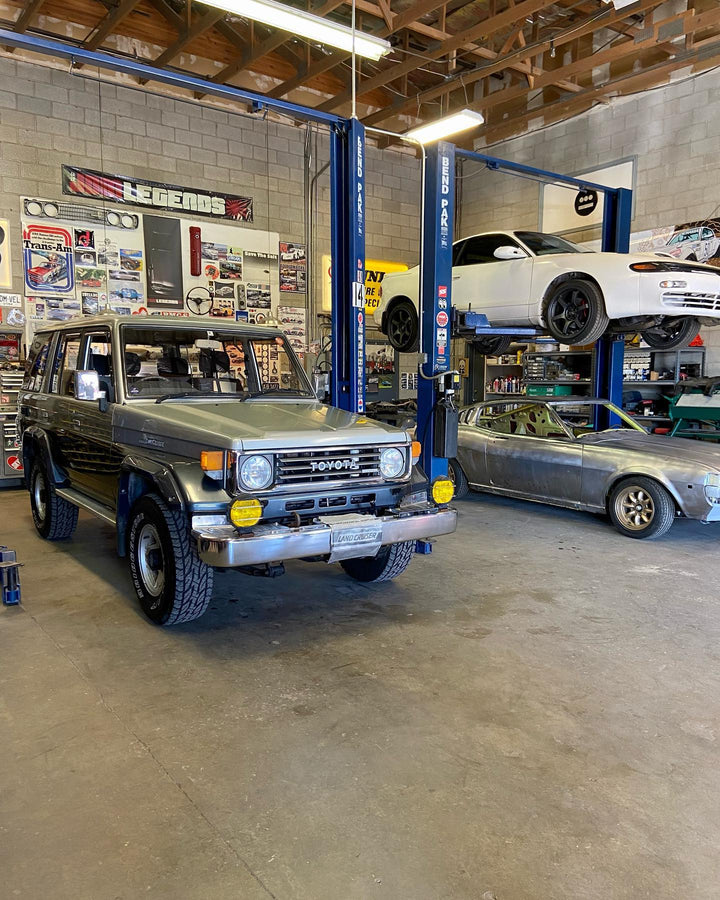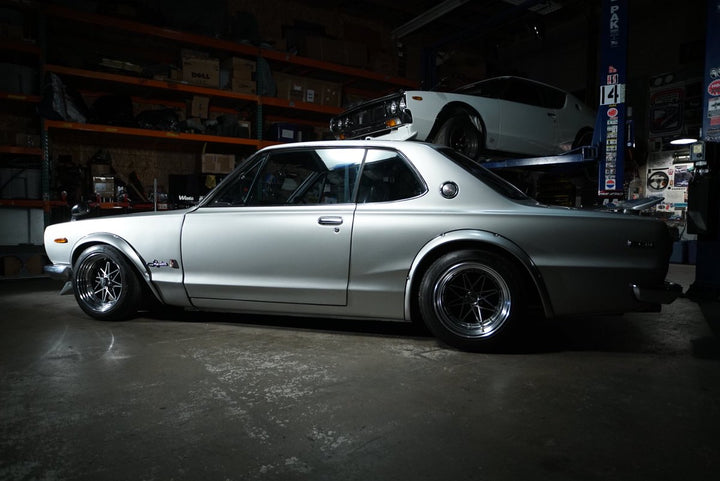










In this part of the Kenmeri build I’m going to go into detail another part of this 73 Skyline that definitely needed some attention before we could consider it fit to be sold. One of the most notable aesthetic features that distinguishes the GT-R from the standard model Skyline has to be the fender flares. When we had received the car it came with some reproduction flares already on it, and from about 10 feet away everything looks peachy but it’s only when you move in for a closer inspection that things start to get ugly. Now anyone who has ever bought any aftermarket body part (especially fiberglass) and prepped and installed it themselves will tell you that you usually get exactly what you pay for. This rings especially true here. Being that there is not an option to acquire OEM flares there is no other choice than to pick up an aftermarket reproduction. There are a few options out there and this car definitely came with what I can only guess are reproductions of reproductions, and were painted and half screwed to the car with no regard for fitment or finish. But wait, it gets worse………..

Now other than the fact that the flares are partially screwed with a variety of philips and flat head and “whatever I could find around the garage floor” hardware, note the fact that you can see the original fender underneath the flare. This was the case on all 4 fenders. Other than it looking ridiculous, it kind of defeats the purpose of installing flares in the first place, to fit wider wheels and more rubber. Instead of trying to salvage the existing flares, we decided to import a set of high quality FRP reproductions from Japan. After waiting a couple of weeks for the flares to arrive it was now time to remove the old ones and properly modify the factory metal fenders.
The front fenders are relatively simple being a single sheet of steel that just needs to be cut up a little higher to make adequate room and repainted. The rears however are much more involved as you will see. Here is a picture of the original factory rear “surfline” fenders.

Quite a difference from the GT-R rear fenders shown here.

Upon removal of the old flares I had noticed that it looked like someone had previously made an attempt to modify the rear fenders but for some reason decided not to cut them up high enough, resulting in the factory fender being visible underneath the flare. After removing some mystery goop I uncovered the initial attempt…

This would have been much easier if I was starting with an unmolested fender, but what fun would that be? I had to first start by grinding off all of the rivets that previously held the inner fender well and quarter panel together. The next step was to draw the line that would be the new fender line and cut it. The line above the cut shows where the new flare will be. Remember, the goal here is to make as much room as possible for some wider, low offset wheels.

After cutting the quarter panel you can see how big of a gap it creates between the fender well.

The next step can be done a couple of different ways depending on what you are looking to achieve. The metal from the quarter panel can either be bent down into the fender well, or vice versa. I decided to bend the metal from the fender well up to meet the quarter panel in this situation as the new flare would cover where the two meet and this would give us a much better finish inside the fender well.
By using a mallet and a fender roller I am able to bend the fender well up and out enough to meet the quarter panel and hold it in place while it gets tack welded. Note the aluminum in between the wheel on the fender roller and the fender well to prevent the wheel from being melted in the welding process.

Make sure to move around the fender as much as possible when making the welds because the last thing you want to do is warp the entire quarter panel from putting too much heat in one spot. I also used a wet rag to assist in the cooling process to be sure. With the majority of tack welds done you can now cut off the excess material.

After finishing up the welds we decided to go the extra mile and fill in any remaining gaps with seam sealer similar to what is used in new cars in place of spot welds. The idea here is to strengthen the bond between the fender well and the quarter panel to retain as much rigidity as possible in the chassis. After that I used some silicone sealant inside the quarter panels which required removing the interior panels inside the cabin and in the trunk to get full access. The last thing you want is for water to get inside only to be trapped and eventually turn to rust.

And this is what’s left after re modifying the fenders.

Now if you just paint the new flares without prepping them properly it will definitely show in the final product. So for our next installment we will prep and paint the new flares, grill, and front spoiler before they find their new home on the Kenmeri in part 4.


8 Comments
holy crap! what a task. how many hours for all fenders for completion???
Hmm….. I don’t know exactly. Probably about 8 hours not including prepping and painting the new flares.
Nice work so far — While I can I appreciate your attention to detail, it makes me cringe when I see RTV used in repairs like this. Take it you’ve never been tasked with removing this stuff before? Highly resistant to solvents, repels all kinds of paints, and you can’t even BURN it out… but I guess this beats rust?
Are you referring to the urethane I used inside the quarter panels? It’s the same stuff used to seal windshields, and it was only used inside the car. Maybe you are dealing with some stuff I am not familiar with. And even if it may be a little difficult to remove, it will always be easier to remove than rust
The silicone sealant inside the quarter panels that you used, is that the same as wax sealant? Basically, covering the rear surface area from the welds from the front to seal from air and moisture? And was a weld through primer used between the inner and outer fender or was there not enough metal to metal surface for that kind of welding since it’s seem like it was a spotted type weld and not a total flat metal surface?
Thanks and sorry for the long ass Q’s
Have always wondered with those overfenders, whether or not you get a sheet with the measurements on where they’re meant to be fitted on the panel with suggestions or a template on where to cut the original panel?
Unfortunately with my experience all that you get (even with the nice ones) is some Japanese newspaper for packing material, and maybe a couple of stickers if you’re lucky. This is where the stacks of GT-R specific literature we have here comes in handy. They have quite a few pictures of genuine GT-R shells without the flares on so you can get a pretty good idea of where to cut. Also, the over fenders really only fit the car well in one spot, so you can place them on the car and trace a line under them to give you a good idea where to cut. A little experience doesn’t hurt either, and unless you feel very comfortable with the process it’s usually best left to the professionals.
[...] been keeping up with our blog I described how I feel is the proper way to do them on our Kenmeri here. There are other ways of doing it as well, this is another [...]